Dollar-Cost Averaging: The Simplest Way to Invest Without Timing the Market
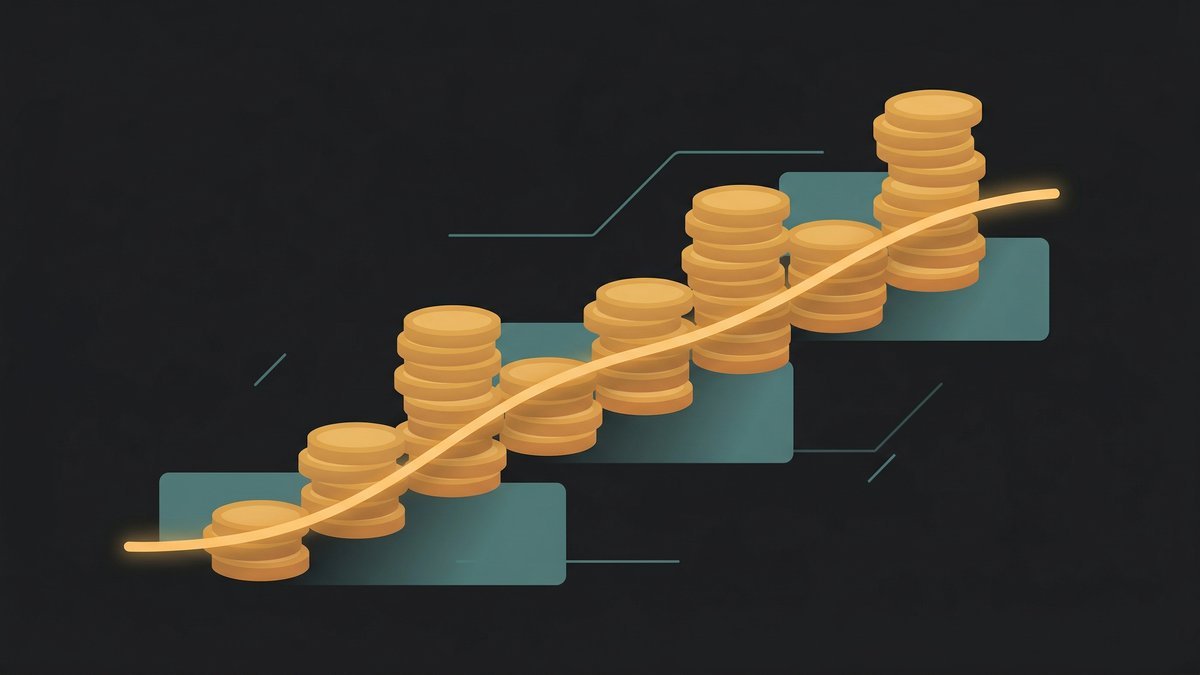
Dollar-cost averaging is the investing strategy that removes the most common reason people never start: fear of buying at the wrong time. Instead of trying to predict whether the market is about to go up or down — something even professional fund managers fail at consistently — you invest a fixed dollar amount on a regular schedule, regardless of what the market is doing.
When prices are high, your fixed contribution buys fewer shares. When prices drop, the same contribution buys more shares. Over time, this naturally lowers your average cost per share and smooths out the impact of volatility. No market research required. No gut feelings. No timing.
If you’re already automating monthly contributions to an index fund, you’re already doing dollar-cost averaging — you just might not have known it had a name. This article explains why the strategy works, when it makes sense, and how to implement it as a repeatable system.
How Dollar-Cost Averaging Works
The mechanics of dollar-cost averaging are simple. You commit to investing a fixed dollar amount at regular intervals — typically monthly or biweekly — into the same investment, regardless of the share price at the time of purchase.
Here’s a concrete example. Suppose you invest $300 per month into an S&P 500 index fund over six months, and the share price fluctuates:
- Month 1: Price $50/share → You buy 6.0 shares
- Month 2: Price $45/share → You buy 6.67 shares
- Month 3: Price $40/share (market dip) → You buy 7.5 shares
- Month 4: Price $38/share (further dip) → You buy 7.89 shares
- Month 5: Price $44/share (recovery) → You buy 6.82 shares
- Month 6: Price $52/share (new high) → You buy 5.77 shares
Total invested: $1,800. Total shares: 40.65. Average cost per share: $44.28.
Notice what happened: you bought more shares when the price was low (months 3 and 4) and fewer when the price was high (months 1 and 6). You didn’t need to know the dip was coming. You didn’t need to “buy low.” The fixed-dollar schedule did it automatically — and your average cost per share ($44.28) is lower than the simple average of the six share prices ($44.83).
That’s the dollar-cost averaging advantage in its simplest form: systematic purchasing that naturally favors lower prices without requiring any market knowledge.
Why Dollar-Cost Averaging Beats Trying to Time the Market
Market timing sounds logical in theory: buy when prices are low, sell when prices are high. In practice, it’s a disaster for almost everyone who tries it.
Research from Charles Schwab studied what happens when you invest $2,000 annually over a 20-year period under five different scenarios:
- Perfect timing (investing at the absolute lowest point each year): Best results — but impossible to execute in real life.
- Immediate investing (investing at the start of each year, no timing): Second-best results — and barely behind perfect timing.
- Dollar-cost averaging (investing monthly throughout each year): Third — close behind immediate investing.
- Bad timing (investing at the absolute highest point each year): Fourth — but still produced strong positive returns over 20 years.
- Staying in cash (never investing, keeping money in savings): Dead last by a massive margin.
The key insight: even the worst possible timer — someone who invested at the peak every single year for 20 years — dramatically outperformed the person who never invested at all. The spread between perfect timing and bad timing was relatively modest. The spread between investing and not investing was enormous.
Dollar-cost averaging lands between the two extremes, producing excellent returns with zero timing skill required. For most people, it’s the ideal approach because it removes the paralyzing question of “when should I invest?” The answer becomes: “on the same day every month, automatically.”
Dollar-Cost Averaging vs. Lump-Sum Investing
Here’s the nuance: if you have a large sum of money available right now (a bonus, inheritance, or tax refund), research shows that investing it all at once — lump-sum investing — outperforms dollar-cost averaging approximately two-thirds of the time. That’s because markets trend upward over time, and money invested earlier has more time to grow.
Vanguard’s analysis found that lump-sum investing beat DCA in about 68% of historical 12-month periods across U.S., U.K., and Australian markets.
So why use dollar-cost averaging at all? Two reasons:
- Most people don’t have a lump sum. They earn a paycheck and invest a portion of it each month. Dollar-cost averaging isn’t a choice for these investors — it’s the natural structure of their cash flow. If you’re investing from a salary, DCA is your default strategy.
- Behavioral protection. Even when you do have a lump sum, the emotional risk of investing it all the day before a 15% market drop is real. Dollar-cost averaging spreads the risk and reduces the chance of investing everything at a short-term peak. If the mathematical edge of lump-sum investing is 2–3% over a year, but you’d panic and sell during a dip, DCA produces better actual results because you’re more likely to stay invested.
The pragmatic rule: if you have a lump sum and strong emotional discipline, invest it all now. If you’re unsure, split it into 3–6 monthly installments via dollar-cost averaging. Either way, the money goes to work — and that’s what matters most.
How to Set Up Dollar-Cost Averaging (10 Minutes)
If you already have a brokerage account or Roth IRA, setting up dollar-cost averaging takes one action: schedule an automatic recurring investment.
Step 1: Choose Your Investment
For most beginners, a single broad-market index fund is the right choice. This gives you instant diversification across thousands of companies:
- VTI (Vanguard Total Stock Market ETF) — entire U.S. stock market
- VOO (Vanguard S&P 500 ETF) — 500 largest U.S. companies
- FZROX (Fidelity ZERO Total Market) — 0.00% expense ratio
Step 2: Set the Amount and Frequency
Decide how much to invest each month based on your budget. Even $100 or $200 per month creates meaningful results over decades thanks to compound interest. The most common frequencies:
- Monthly: The most popular. One investment per month, typically the day after payday.
- Biweekly: Aligns with biweekly pay cycles. Results in 26 investments per year instead of 12 — slightly more frequent averaging.
- Weekly: The finest granularity. Slightly better theoretical averaging, but the practical difference from monthly is negligible for long-term investors.
Monthly is the sweet spot for simplicity and effectiveness.
Step 3: Automate It
In your brokerage account (Fidelity, Schwab, Vanguard), navigate to “Automatic Investments” or “Recurring Investments.” Select your fund, your dollar amount, and your schedule. The platform handles everything from there — buying shares on your chosen date, every month, without your involvement.
This is the step that transforms dollar-cost averaging from a strategy into a system. You set it once. It runs forever. Automation is the engine — dollar-cost averaging is the fuel injection pattern.
A Real-World Example: Dollar-Cost Averaging Through a Market Crash
Rachel is 29 and started investing $250/month into a total stock market index fund in January 2019. She didn’t know a pandemic was coming in 2020. She didn’t predict the market crash. She just had an automatic monthly investment running.
Here’s what happened to Rachel’s dollar-cost averaging strategy through the COVID crash:
- Jan 2019 – Feb 2020: Market rising. Her $250/month bought shares at increasingly higher prices. Portfolio growing steadily.
- March 2020: Market drops 34%. Rachel’s portfolio loses significant value on paper. But her $250 automatic investment still fires — and it buys shares at a 34% discount. She acquires more shares this month than any month prior.
- April–August 2020: Market recovers. The shares Rachel bought at deeply discounted prices in March surge in value. Her average cost basis is now significantly lower because of those crisis-month purchases.
- By December 2020: Rachel’s portfolio has not only recovered — it’s higher than it was before the crash, partly because her dollar-cost averaging bought aggressively at the bottom without her doing anything differently.
Rachel didn’t “buy the dip” on purpose. She didn’t make a bold market call. The system did what it always does: invested the same amount on the same day. The crash, counterintuitively, helped her — because she was buying through it rather than watching from the sideline.
The investors who got hurt in 2020 were the ones who panicked, sold at the bottom, and waited to re-enter. Rachel’s dollar-cost averaging approach protected her from her own emotions — which is exactly what it’s designed to do.
When Dollar-Cost Averaging Doesn’t Make Sense
Dollar-cost averaging is excellent for most people in most situations. But there are scenarios where it’s suboptimal:
- If you’re holding a large lump sum in cash for months. Waiting 12 months to dollar-cost average a $50,000 inheritance means that money sits idle while markets (historically) trend upward. If you can handle the short-term volatility, investing the lump sum immediately has better expected returns.
- If you’re using it as an excuse to delay. Some people say “I’m dollar-cost averaging” when what they really mean is “I haven’t started yet.” DCA works when the automatic investment is already running. It doesn’t work if it’s a plan you haven’t implemented.
- In steadily rising markets. During prolonged bull markets, each month’s purchase is at a higher price than the last. Lump-sum investing at the beginning would have captured more gains. However, you can’t know in advance whether the next 12 months will be a bull market — which is why DCA’s risk reduction is still valuable as insurance.
Dollar-Cost Averaging and the Bigger Financial System
Dollar-cost averaging doesn’t exist in isolation. It’s one component of a repeatable financial system:
- Your budget determines how much surplus cash is available each month.
- Your emergency fund ensures you won’t need to sell investments in a crisis.
- Your automation system moves money into your investment account on payday.
- Dollar-cost averaging turns that automated deposit into purchased shares — consistently, regardless of market conditions.
- Compound interest takes over and grows those shares exponentially over decades.
Each piece supports the others. Removing any one step weakens the system. Dollar-cost averaging is the mechanism that converts regular cash flow into long-term wealth — and it works precisely because it’s boring, automatic, and emotionally neutral.
Frequently Asked Questions
What is dollar-cost averaging in simple terms?
Dollar-cost averaging means investing a fixed dollar amount on a regular schedule — typically monthly — regardless of whether the market is up or down. When prices are low, your fixed amount buys more shares. When prices are high, it buys fewer. Over time, this produces a lower average cost per share than trying to time your purchases.
Is dollar-cost averaging better than lump-sum investing?
Mathematically, lump-sum investing outperforms dollar-cost averaging about two-thirds of the time because markets tend to rise over time. However, dollar-cost averaging reduces the risk of investing a large sum right before a downturn and is psychologically easier for most people. For investors who receive income via regular paychecks, dollar-cost averaging is the natural and most practical approach regardless.
How often should I invest with dollar-cost averaging?
Monthly is the most common and practical frequency. It aligns with most pay cycles and is simple to automate. Biweekly works well for biweekly paychecks. Weekly investing provides slightly finer averaging, but the long-term difference compared to monthly is negligible. Consistency matters more than frequency — pick a schedule and stick with it.
The Bottom Line
Dollar-cost averaging is the investing strategy that makes “I don’t know when to invest” completely irrelevant. You invest on the same day every month. The market goes up, you invest. The market crashes, you invest. You don’t read charts, don’t follow pundits, and don’t try to outsmart a system that humbles even the professionals.
The data is clear: staying invested consistently over time produces dramatically better outcomes than waiting for the perfect entry point — because the perfect entry point is only visible in hindsight. Dollar-cost averaging accepts that reality and turns it into an advantage.
Set up your automatic monthly investment. Let the system run. And let compound interest do what it does best: turn consistency into wealth.
This article is for educational and informational purposes only. It does not constitute personalized financial or investment advice. Always consult a qualified financial professional before making investment decisions.
Ready to build your investing system? The free Wealth Starter Kit covers all 7 financial fundamentals — from budgeting to automation to your first investment. Get the free playbook here.