How to Start Investing with $1,000 or Less: A Beginner’s Step-by-Step Guide

If you’ve been wondering how to start investing with $1,000, here’s the short answer: open a brokerage account, buy a low-cost index fund, set up automatic monthly contributions, and leave it alone. The whole process takes about 20 minutes. Not 20 hours of research. Not a finance degree. Twenty minutes and a Wi-Fi connection.
The longer answer — which is what this article covers — walks through exactly where to put that $1,000, which account type to choose, which investments make sense for a beginner, and how to turn a single deposit into a system that compounds over decades. Because the goal isn’t just to invest a thousand dollars once. It’s to build a repeatable habit that turns into real wealth.
Most people who haven’t started investing yet aren’t held back by a lack of money. They’re held back by a lack of clarity. This guide eliminates the ambiguity.
Before You Invest: Two Boxes to Check
Before learning how to start investing with $1,000, make sure two financial foundations are in place. These aren’t optional — skipping them creates problems that undo your investment gains.
1. Eliminate High-Interest Debt First
If you’re carrying credit card debt at 20%+ interest, your first $1,000 should go toward paying that down. No investment consistently returns 20% per year. Paying off a 22% credit card is the equivalent of earning a guaranteed 22% return on your money. That’s the best “investment” available to you right now.
Low-interest debt (student loans under 6–7%, car payments) can coexist with investing. High-interest debt cannot.
2. Build a Starter Emergency Fund
Before you invest, set aside at least $500–$1,000 in a high-yield savings account as a mini emergency buffer. This prevents you from selling your investments at a loss when an unexpected expense hits. If you already have this buffer, you’re ready to invest.
How to Start Investing with $1,000: Step by Step
Here’s the exact process, from zero to invested, in four steps.
Step 1: Choose the Right Account Type
The account you invest through matters almost as much as what you invest in. There are two main options for beginners:
Roth IRA — If you’re under 50 and your income is below $161,000 (single) or $240,000 (married filing jointly), a Roth IRA is likely your best first move. You contribute after-tax dollars, your investments grow tax-free, and withdrawals in retirement are completely tax-free. The 2026 contribution limit is $7,000 per year. Your $1,000 fits comfortably within that.
Taxable Brokerage Account — If you’ve already maxed your Roth IRA, or if you want more flexibility (no withdrawal restrictions), a standard brokerage account works. You’ll pay capital gains taxes on profits when you sell, but there are no contribution limits and no penalties for accessing your money.
For most beginners learning how to start investing with $1,000, a Roth IRA is the better choice. The tax-free growth over 30+ years is an enormous advantage.
Step 2: Open Your Account (15 Minutes)
Pick one of these three brokerages — all are reputable, beginner-friendly, and charge $0 commissions on stock and ETF trades:
- Fidelity — Offers fractional shares (“Stocks by the Slice”) on 7,000+ stocks and ETFs starting at $1. Excellent app and educational resources. Also offers the FZROX total market index fund with a 0.00% expense ratio.
- Charles Schwab — “Stock Slices” lets you buy fractional shares of any S&P 500 company starting at $5. Strong research tools and customer support.
- Vanguard — Founded by the inventor of the index fund. Slightly less polished interface, but rock-solid for long-term, low-cost investing.
According to Bankrate’s 2026 brokerage comparison, all three offer fractional shares, automatic investing, and dividend reinvestment at no extra cost. You’ll need your Social Security number, bank account details, and about 15 minutes to complete the application.
Step 3: Invest the $1,000
Here’s where most people overthink it. You don’t need to spread $1,000 across 15 different funds. For a beginner, simplicity wins. Here are three approaches ranked by complexity:
Option A: The Simplest (Recommended)
Put the entire $1,000 into a single broad-market index fund. One fund, instant diversification across hundreds or thousands of companies. Done.
- Vanguard Total Stock Market ETF (VTI) — holds 4,000+ U.S. stocks. Expense ratio: 0.03%.
- Fidelity ZERO Total Market Index (FZROX) — holds 2,600+ stocks. Expense ratio: 0.00%.
- Schwab U.S. Broad Market ETF (SCHB) — holds 2,500+ stocks. Expense ratio: 0.03%.
If you want exposure to just the 500 largest companies, the S&P 500 equivalents (VOO, FXAIX, or SCHX) work just as well.
Option B: The Core + Satellite
Allocate 80% ($800) to a broad U.S. index fund and 20% ($200) to an international index fund for global diversification:
- $800 → VTI or VOO (U.S. market)
- $200 → VXUS (international stocks) or VEA (developed international markets)
Option C: The Three-Fund Portfolio
A classic beginner allocation recommended by the Bogleheads community:
- $600 → U.S. total market (VTI)
- $200 → International stocks (VXUS)
- $200 → U.S. bonds (BND)
For investors in their 20s and 30s with a long time horizon, Option A or B is generally preferred — you have decades for the stock market to recover from any downturns, and bonds provide less growth potential over that timeframe.
Step 4: Set Up Automatic Monthly Investments
This is the step that transforms a one-time $1,000 deposit into a wealth-building engine. After your initial investment, set up an automatic recurring contribution — even $50 or $100 per month. This is called dollar-cost averaging, and it’s one of the most powerful concepts in investing.
Dollar-cost averaging means you buy more shares when prices are low and fewer when prices are high, automatically smoothing out market volatility over time. You don’t need to predict the market. The system handles it.
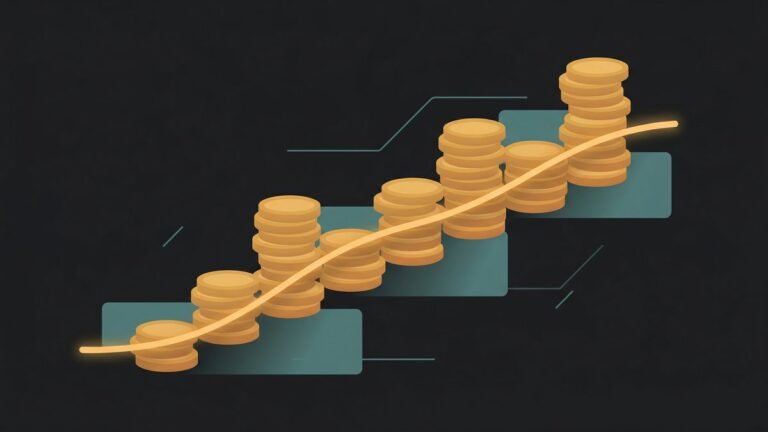
Here’s what this looks like at different monthly contribution levels (assuming 10% average annual return):
- $1,000 initial + $50/month for 30 years: ~$117,000
- $1,000 initial + $100/month for 30 years: ~$217,000
- $1,000 initial + $200/month for 30 years: ~$416,000
- $1,000 initial + $300/month for 30 years: ~$614,000
That first $1,000 matters — but the monthly habit is what creates life-changing results. Automate it so it happens without your involvement.
A Real-World Example: Turning $1,000 Into a System
Ava is 27 and works as a graphic designer earning $52,000. She’s been meaning to invest for three years but kept delaying — partly because she thought she needed more money, partly because the options felt overwhelming.
One Saturday morning, she opens a Roth IRA at Fidelity. It takes 12 minutes. She transfers $1,000 from her checking account and buys shares of FZROX, Fidelity’s zero-fee total market index fund. She sets up an automatic $100 monthly contribution scheduled for the day after each payday.
Total time: 20 minutes. Total ongoing effort: zero.
One year later, Ava has $2,350 invested (her initial $1,000 plus $100/month for 12 months, plus market growth). She didn’t check the account obsessively. She didn’t panic when the market dipped 8% in March. She let the system run. By 40, if she changes nothing else, she’ll have roughly $80,000. By 57, over $400,000 — most of which was generated by compound growth, not her contributions.
The starting point wasn’t a windfall. It was a decision to stop waiting.
5 Mistakes to Avoid When You Start Investing with $1,000
- Spreading the money too thin. Buying 15 different ETFs with $1,000 doesn’t create diversification — it creates confusion. One or two broad-market index funds give you exposure to thousands of companies. Keep it simple.
- Chasing hot stocks or meme trades. Your $1,000 isn’t play money. It’s the foundation of a long-term system. Putting it into volatile individual stocks based on social media tips is speculation, not investing.
- Waiting for the “right time” to invest. Market timing doesn’t work for professionals, and it definitely doesn’t work for beginners. The best time to invest is when you have the money available. Time in the market beats timing the market — consistently.
- Ignoring account type. Investing $1,000 in a taxable brokerage when you could use a Roth IRA means paying taxes on your gains that you didn’t need to pay. Choose the right account before choosing the right fund.
- Investing without an emergency fund. If you invest your only $1,000 and then need it for an unexpected expense two weeks later, you’ll sell at whatever price the market offers — possibly at a loss. Build the buffer first.
How to Start Investing with $1,000: What Not to Overcomplicate
The investing industry wants you to believe this is complicated. Complicated means you need their products, their advisors, their premium platforms. The reality for a beginner with $1,000 is far simpler:
- You don’t need a financial advisor for $1,000. You need a brokerage account and an index fund.
- You don’t need to understand candlestick charts, P/E ratios, or options strategies. You need to understand that the stock market has averaged roughly 10% annual returns over the long term and that compound interest rewards patience.
- You don’t need to read financial news daily. You need to automate a monthly contribution and check in once a quarter.
The budgeting system and the investing system work together. One controls the flow of money. The other puts it to work. Both should run on autopilot.
Frequently Asked Questions
Is $1,000 enough to start investing?
Yes — $1,000 is more than enough to start investing. With fractional shares now available at every major brokerage, you can buy into diversified index funds with as little as $1. What matters more than the starting amount is building a consistent monthly contribution habit. The initial $1,000 gets you into the market; the recurring investments build wealth.
Should I invest $1,000 all at once or spread it out?
Research from Vanguard consistently shows that lump-sum investing (investing the full amount immediately) outperforms dollar-cost averaging about two-thirds of the time. For $1,000, the difference is minimal either way. If you’re nervous about investing it all at once, split it into two or four monthly investments — $500 per month for two months or $250 per month for four months. The key is to get started, not to optimize the timing.
What’s the difference between a Roth IRA and a regular brokerage account?
A Roth IRA is a tax-advantaged retirement account: you invest after-tax dollars, your money grows tax-free, and withdrawals in retirement are tax-free. A regular brokerage account has no tax advantages but also no contribution limits or withdrawal restrictions. For most beginners under 50, a Roth IRA should be the first account you open because the tax-free compounding over decades is extremely valuable.
Can I lose all my money investing in index funds?
A broad-market index fund holds hundreds or thousands of companies. For you to lose everything, every single company in the fund would need to go to zero simultaneously — which has never happened in the history of U.S. markets. Index funds absolutely can lose value in the short term (10–30% drops happen periodically), but over 15+ year periods, broad-market index funds have historically always recovered and produced positive returns.
The Bottom Line
Figuring out how to start investing with $1,000 doesn’t require expertise. It requires a decision. Open a Roth IRA or brokerage account at Fidelity, Schwab, or Vanguard. Put the $1,000 into a single broad-market index fund. Set up an automatic monthly contribution of whatever you can afford. Walk away.
That’s the entire strategy. The market does the compounding. The automation does the discipline. Your only job is to start — and then not interfere.
A thousand dollars isn’t a fortune. But it’s the first brick. And every fortune started with one.
This article is for educational and informational purposes only. It does not constitute personalized financial or investment advice. Always consult a qualified financial professional before making investment decisions.
Want the complete framework? My free Wealth Starter Kit covers the 7 financial fundamentals — from budgeting to opening your first investment account. Get the free playbook here.